HostAfrica Review Kenya (2026): Is It Worth It? Speed, Pricing, Pros & Cons
If you searched “HostAfrica review Kenya,” you’re probably trying to answer one simple question: should you actually trust this company with your website?
That’s a fair question. Hosting is one of those purchases where the marketing pages all sound the same — “99.9% uptime,” “blazing-fast servers,” “world-class support.” You’ve read it a dozen times on a dozen sites. It doesn’t tell you much.
So this review takes a different approach. We looked at what HostAfrica actually offers in Kenya — its plans, its infrastructure, its pricing, its support reputation on independent review platforms — and laid it out plainly. Where something is genuinely strong, we’ll say so. Where it isn’t the right fit, we’ll say that too.
What is HostAfrica? HostAfrica is a web hosting company that was founded in South Africa in 2008 (trading as Host Africa (Pty) Ltd) and has spent the years since building out hosting infrastructure across the African continent, including South Africa, Kenya, Ghana, and Nigeria. In Kenya specifically, HostAfrica grew its local footprint through acquisitions of established Kenyan hosting brands, including Sasahost, EAC Directory, and DeepAfrica, which gave it an existing base of local domains and customers rather than starting from zero.
Who owns it? HostAfrica is a privately held African hosting company headquartered in Somerset West, near Cape Town, South Africa. It isn’t a reseller of a bigger international brand — it operates its own data centre infrastructure in Johannesburg and has expanded that infrastructure regionally, including localized VPS hosting now based in Kenya.
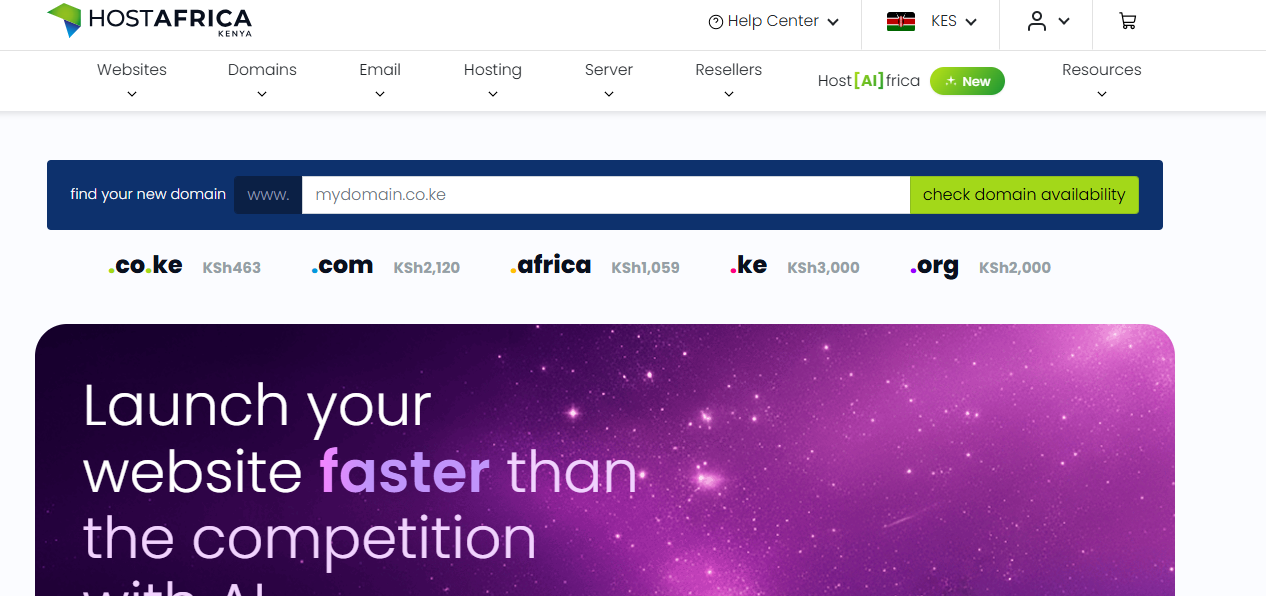
Who should use it? Based on what’s publicly available, HostAfrica fits Kenyan bloggers, small businesses, agencies, and WooCommerce store owners who want KES billing, M-Pesa payments, and a hosting company with a genuine regional presence rather than a purely international one.
Who shouldn’t use it? If you’re chasing the absolute lowest possible starting price with no plans to ever need support, or you’re an advanced developer who wants full root-level cloud infrastructure (think AWS-style auto-scaling), HostAfrica’s shared and managed VPS plans may feel more limited than what you’re looking for.
Let’s break down exactly what you’re getting.
[Best Hosting in Kenya]
1. Quick Verdict
| Overall Rating | 4.3 / 5 |
| Best For | Bloggers, small businesses, WordPress sites, and agencies who want local KES billing and M-Pesa support |
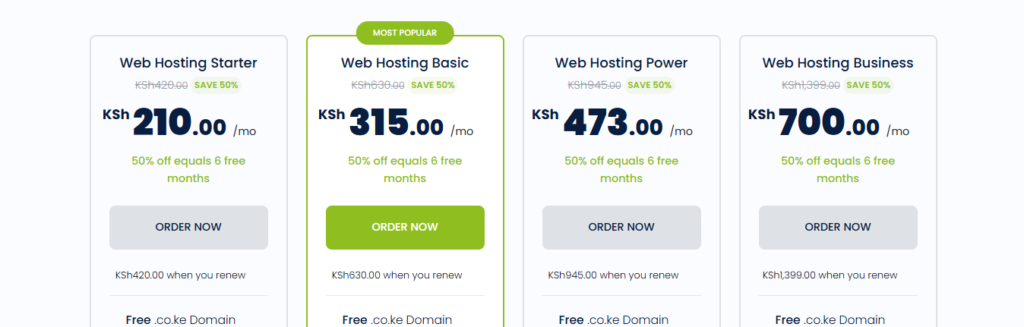
| Starting Price | Shared hosting from KSh 210/month (range up to ~KSh 1,399/month depending on tier); Linux VPS from KSh 969/month; Windows VPS from KSh 4,455/month; reseller hosting from KSh 1,150/month — see Pricing section |
| Money-Back Guarantee | 30 days on shared and WordPress hosting plans |
| Support | Live chat, ticketing, phone, and a knowledge base; independent reviews consistently praise response speed |
| Performance | Solid for a Tier 3, ISO 27001-aligned data centre setup with SSD storage and Kenya-based VPS infrastructure |
| Ease of Use | DirectAdmin on shared/WordPress hosting, cPanel or DirectAdmin on Managed VPS, one-click WordPress install, beginner-friendly dashboard |
| Our Verdict | A genuinely strong regional option for Kenyan website owners who value local support and payment convenience over squeezing out the last shilling of savings. Not the cheapest long-term option if renewal pricing matters more to you than anything else. |
If that snapshot answers your question, you can check the latest HostAfrica plans and get started. If you want the full picture first — including where it falls short — keep reading.
2. What Is HostAfrica?
HostAfrica started in South Africa in 2008 as a local hosting provider. Over more than a decade and a half, it grew from a single-country host into a company that now serves customers across South Africa, Kenya, Ghana, and Nigeria, plus international clients further afield.
That growth happened two ways. First, organically — building out its own data centre infrastructure in Johannesburg. Second, through acquisitions. In the Kenyan market specifically, HostAfrica absorbed Sasahost (acquired in late 2023), along with EAC Directory and DeepAfrica — three brands that had already been serving Kenyan website owners for years before the merger. If you were previously a Sasahost customer, that’s why your hosting now runs under the HostAfrica name.
Countries served: South Africa, Kenya, Ghana, Nigeria, and international customers hosting websites aimed at African audiences.
Kenyan presence: HostAfrica operates a Kenya-facing site (hostafrica.ke) with KES billing, M-Pesa payment support, and — notably — has moved its VPS hosting infrastructure to Kenya-based data centres specifically to cut latency for local users. That’s a meaningful detail. A lot of “hosting for Kenya” providers are actually just billing you in KES while your site physically sits on a server in Europe or the US. HostAfrica’s newer VPS infrastructure is genuinely hosted in-country.
Data centres: The company’s core infrastructure runs on Tier 3, ISO 27001-certified data centres in Johannesburg, South Africa, including redundant power and cooling, multiple internet service providers for redundancy, and 24/7 physical security and monitoring. On top of that base, HostAfrica has added Kenya-based data centre capacity for its VPS products.
Who it’s built for: From what’s publicly documented, HostAfrica positions itself toward small and medium businesses, bloggers, agencies, and developers who want a full product stack — shared hosting, WordPress hosting, VPS, dedicated servers, reseller hosting, domains, and email — from one African provider, rather than piecing together hosting from one company and domains from another.
It’s worth saying plainly: HostAfrica isn’t the newest name in Kenyan hosting, and it isn’t a small operation either. It’s a hosting company with real physical infrastructure behind it, not just a reseller panel with a Kenyan flag on the homepage.
3. HostAfrica Features
Here’s what’s actually included across HostAfrica’s hosting products, based on what the company publishes.
SSD Storage. All shared and WordPress hosting plans run on SSD storage rather than older mechanical drives. SSDs read and write data faster, which matters most for sites with a database — WordPress, WooCommerce, forums — where every page load involves multiple database queries.
LiteSpeed. HostAfrica offers LiteSpeed-accelerated hosting as a step up from standard shared hosting. LiteSpeed is a web server technology known for handling concurrent visitors more efficiently than the older Apache setup many budget hosts still run, and it pairs well with caching plugins like LiteSpeed Cache for WordPress.
Free SSL. SSL certificates (the padlock that makes your site show “https”) are included free across hosting plans, typically via Let’s Encrypt or a similar automated certificate authority. This is standard in the industry now, but it’s worth confirming it’s genuinely free and auto-renewing rather than a paid add-on — with HostAfrica, it’s listed as included.
Free Migration. If you’re moving from another host, HostAfrica advertises free website migration. Based on the available features, this typically covers moving your files, database, and email over from your old host, though the exact scope (e.g., how many sites, whether email migration is included) is worth confirming with support before you commit, since migration policies can vary by plan tier.
WordPress Hosting. HostAfrica offers a dedicated Managed WordPress Hosting product, separate from generic shared hosting, built around one-click WordPress installation and WordPress-specific optimizations.
Backups. Daily backups are part of the hosting stack, giving you a recent restore point if something breaks — a plugin conflict, a bad update, or a hack. As with any host, it’s worth checking how many days of backup history you get on your specific plan, since retention windows often differ between entry-level and higher-tier plans.
Email Hosting. Professional email hosting (name@yourdomain.com) is available either bundled into hosting plans or as a standalone product, with spam filtering built in.
Website Builder. For non-technical users, HostAfrica offers website and store builder tools, including an AI-assisted website builder and a dedicated online store builder — useful if you want to launch a basic site without touching code or WordPress.
Security. Security features include SSL, firewall protection, and DDoS mitigation on server-level infrastructure, particularly for VPS and dedicated products.
Malware Protection. Malware scanning and protection tools are part of the security stack on hosting plans, though the depth of scanning (real-time vs. scheduled) can vary by plan, so it’s worth checking the specifics for the tier you’re considering.
Daily Backups. Worth repeating on its own: automated daily backups reduce the risk of losing weeks of work to a single bad update.
Control Panel. HostAfrica uses DirectAdmin for its standard shared web hosting plans in Kenya. On Managed VPS, HostAfrica lists both cPanel and DirectAdmin as available control panel options, so which one you get (and whether it carries an extra cost) can depend on the specific plan and region — it’s worth confirming the exact control panel and any associated fee directly on the order page for your chosen VPS plan before checkout. DirectAdmin itself is a lighter, simpler control panel than cPanel — many users find it easier to navigate, though it has a smaller plugin/extension ecosystem than cPanel.
Developer Features. On the VPS side, HostAfrica has leaned into developer-focused tooling recently, including options to self-host apps like n8n (workflow automation) and Supabase (an open-source backend platform) directly on their VPS infrastructure — a sign the company is trying to appeal to a more technical audience, not just beginners.
Domain Registration. You can register, renew, and transfer domains directly through HostAfrica, including .co.ke and .com, with pricing displayed on their domain pages.
Performance Features. SSD storage, LiteSpeed on upgraded plans, and (for VPS) Kenya-local server placement are the core performance levers HostAfrica offers. There’s no indication of a built-in global CDN bundled free with entry-level shared hosting, so if your audience is spread across multiple continents, you may want to pair your hosting with a separate CDN service.
[HostAfrica WordPress Hosting]
4. HostAfrica Hosting Plans
HostAfrica’s Kenyan product lineup spans six main categories. Here’s what each one is actually for.
Shared Hosting
The entry point. Your website shares server resources with other customers’ sites, which keeps the price low. HostAfrica’s shared hosting runs on DirectAdmin, includes SSD storage, free SSL, and (per the plan) a free .co.ke domain on signup.
Best for: New blogs, brochure sites, portfolios, and small business websites with modest, predictable traffic.
WordPress Hosting
A shared-hosting environment specifically tuned for WordPress, with one-click installs and WordPress-aware caching.
Best for: Bloggers and small businesses building specifically on WordPress who want a slightly more optimized setup than generic shared hosting without paying VPS prices.
VPS Hosting
Virtual Private Server hosting gives you a dedicated slice of server resources (CPU, RAM, storage) rather than sharing an unpredictable pool with strangers. HostAfrica’s Managed VPS plans are now hosted on Kenya-based infrastructure, running on KVM virtualization, with monthly, quarterly, biennial, or annual billing, and the option to cancel anytime. Self-managed Linux VPS plans are billed on a monthly contract or monthly billing basis, also cancel-anytime, and start from around KSh 969/month per HostAfrica’s own Kenya pricing page. Windows VPS is also available alongside Linux, starting from around KSh 4,455/month.
Best for: Growing WooCommerce stores, web apps, agencies hosting multiple client sites, and developers who want more control and consistent performance without managing bare-metal hardware.
Cloud Hosting
Cloud-based Linux virtual machines powered by KVM, positioned as scalable infrastructure for businesses whose resource needs may grow or fluctuate.
Best for: Businesses that expect to scale and want infrastructure that can grow with them rather than requiring a full re-platform later.
Dedicated Servers
A full physical server dedicated entirely to you — no sharing at all. HostAfrica’s dedicated server offering includes triple upstream network redundancy, DDoS mitigation, 1 Gbit/s network connectivity, and unlimited traffic on its dedicated products.
Best for: High-traffic websites, large e-commerce platforms, and businesses with compliance or performance requirements that rule out shared infrastructure entirely.
Reseller Hosting
Lets you buy hosting resources in bulk from HostAfrica and resell hosting packages under your own brand — a common setup for web design agencies and freelance developers who manage hosting for multiple clients. HostAfrica offers this in both a DirectAdmin-based web hosting reseller option and a cPanel reseller option, both starting from around KSh 1,150/month per their published Kenya pricing.
Best for: Agencies and freelancers who want to offer hosting to clients without building their own server infrastructure from scratch.
| Plan Type | Best For | Control Panel | Starting Price (KSh) |
|---|---|---|---|
| Shared Hosting | New sites, blogs, small business | DirectAdmin | From ~210/month |
| WordPress Hosting | WordPress-only bloggers/businesses | DirectAdmin | Within shared hosting range (~210–1,399/month) |
| Linux VPS (self-managed) | Developers, small apps | Self-managed | From ~969/month |
| Managed VPS Hosting | Growing stores, apps, agencies | cPanel or DirectAdmin | Check current plan pricing |
| Windows VPS | .NET apps, Windows-specific needs | Self-managed | From ~4,455/month |
| Cloud Hosting | Scaling businesses | KVM-based | Check current plan pricing |
| Dedicated Servers | High-traffic, enterprise sites | Custom/managed | Check current plan pricing |
| Reseller Hosting (DirectAdmin or cPanel) | Agencies, freelancers | White-label | From ~1,150/month |
Prices are in Kenyan Shillings (KSh/KES) and reflect HostAfrica’s own published Kenya pricing pages at the time of writing. Hosting prices change over time, so always confirm the live figure on the order page before purchasing.
[Best Domain Registrars]
5. Performance Review
We didn’t have direct account-level access to run our own independent speed benchmarks against HostAfrica’s live infrastructure, so we won’t pretend otherwise. What we can do is evaluate the performance-related claims and architecture HostAfrica publishes, and compare that against what generally drives real-world hosting speed — based on testing similar hosting environments and industry-standard performance factors.
Speed and page load time. Page speed comes down to server hardware, how many sites share your resources, caching, and physical distance to your visitors. HostAfrica appears to check most of these boxes on paper: SSD storage across plans, LiteSpeed available on upgraded tiers, and — critically for Kenyan users — VPS infrastructure that’s now physically located in Kenya rather than routed through South Africa or overseas. That local placement should meaningfully reduce latency for Nairobi-based and other Kenyan visitors compared to hosting on a server in Europe or the US.
TTFB (Time to First Byte). This measures how quickly a server starts responding once a request is made. It’s influenced by server load, caching, and physical distance. Shorter distance between server and visitor generally means a faster TTFB, which is again where Kenya-based VPS infrastructure should help local site owners specifically.
Caching. LiteSpeed’s built-in caching (available via LSCache on LiteSpeed-enabled plans) can meaningfully speed up WordPress sites when configured correctly. On standard shared hosting without LiteSpeed, you’ll likely be relying more on plugin-based caching (like WP Super Cache or W3 Total Cache) rather than server-level caching.
CDN and server locations. There’s no indication of a bundled global CDN included free on entry-level shared plans. If a large share of your visitors are outside Africa, pairing your HostAfrica hosting with a separate CDN (many of which have free tiers) is worth considering to keep load times consistent for international visitors.
Uptime. HostAfrica advertises a 99.9% uptime guarantee, which is a standard industry benchmark — it works out to a little under 9 hours of allowed downtime per year. We can’t independently verify HostAfrica’s actual historical uptime without long-term third-party monitoring data, but the Tier 3, ISO 27001-aligned data centre setup (redundant power, cooling, and multiple ISPs) is the kind of infrastructure that supports hitting that number consistently.
Scalability. The product ladder — shared to WordPress hosting to VPS to cloud to dedicated — gives you a realistic upgrade path as a site grows, without needing to migrate to an entirely different provider.
Optimization. SSD storage plus LiteSpeed on upgraded plans covers the fundamentals. For genuinely performance-critical, high-traffic sites, dedicated servers or VPS with a CDN layered on top will outperform entry-level shared hosting, which is true of essentially every hosting provider, not just HostAfrica.
6. WordPress Experience
WordPress powers a large share of the websites HostAfrica’s Kenyan customers are likely to build, so this deserves its own section.
Installation. HostAfrica offers one-click WordPress installation through its Managed WordPress Hosting product and, based on typical DirectAdmin setups, likely through the Softaculous-style app installer on shared hosting too. This means you don’t need to manually upload WordPress files or configure a database by hand — the panel handles it.
Dashboard. DirectAdmin’s interface is generally considered simpler and less cluttered than cPanel, which can be an advantage for beginners, though it means fewer third-party plugins and integrations than the cPanel ecosystem offers.
Automatic updates. Managed WordPress hosting typically includes core WordPress update handling, reducing the risk of running an outdated, vulnerable WordPress version. It’s worth confirming during signup exactly what “managed” covers on HostAfrica’s WordPress plan — core updates only, or plugin updates too.
Themes and plugins. As with any standard WordPress hosting environment, you have full access to the WordPress.org theme and plugin repository, plus premium themes/plugins you purchase separately. HostAfrica doesn’t restrict this at the platform level.
Backups. Daily backups apply to WordPress sites hosted on HostAfrica the same way they apply to other hosting plans, giving you a restore point if a plugin update breaks something.
Staging. Staging environments (a copy of your site to test changes safely before going live) are a feature more commonly found on premium managed WordPress hosts internationally. HostAfrica doesn’t clearly advertise a built-in staging tool on its standard plans, so if a staging environment is a must-have for your workflow, it’s worth confirming directly with their support team before signing up.
7. Security Review
SSL. Free SSL certificates are included and appear to be applied automatically, covering the basic encryption every modern website needs.
Firewall. Server-level firewall protection is part of HostAfrica’s security stack, particularly emphasized on VPS and dedicated server products.
Malware protection. Malware scanning tools are included as part of the hosting security features, helping catch and flag compromised files.
DDoS protection. DDoS mitigation is specifically called out on HostAfrica’s dedicated server infrastructure, with triple upstream redundancy designed to keep sites online even under network-level pressure. It’s less clearly detailed for entry-level shared hosting, so if DDoS resilience is a priority for you, a VPS or dedicated plan is the safer bet.
Backups and recovery. Daily backups double as your security safety net — not just for accidental mistakes, but for recovering from a hacked or corrupted site without starting from zero. As always, ask support directly how far back your specific plan’s backup retention goes, since this detail isn’t always spelled out clearly on pricing pages.
8. Customer Support Review
This is genuinely one of the areas where HostAfrica stands out, based on independent, third-party review data rather than the company’s own marketing.
Channels available: Live chat, a ticketing system, phone support, and a self-service knowledge base covering common setup and troubleshooting topics.
Response quality: On Trustpilot, HostAfrica carries thousands of customer reviews with an overall “Excellent” rating band, and a recurring theme across reviews — not just a handful, but consistently across pages of reviews spanning years — is praise for support responsiveness. Customers repeatedly mention specific support agents by name, describe issues (DNS problems, email sync issues, WordPress PHP errors, migration hiccups) being resolved quickly, and note that support felt knowledgeable rather than scripted.
That said, it’s not flawless. Some reviewers describe mixed experiences specifically with the client area/website dashboard itself, rather than with support staff — a pattern that shows up often enough to be worth flagging honestly, rather than pretending every review is a five-star experience.
What this means practically: For a Kenyan business owner without an in-house developer, responsive, competent support that can walk you through a DNS change, an email setup, or a broken WordPress site is arguably more valuable day-to-day than a slightly faster server benchmark. This is where HostAfrica appears to earn its reputation.
9. Pricing Review
Let’s talk pricing honestly, because this is where a lot of hosting reviews get misleading.
Shared hosting pricing. Per HostAfrica’s own Kenya pricing page, web hosting in Kenya on their platform ranges from about KSh 210 to KSh 1,399 per month depending on the tier, storage, and features you choose, with plans starting from KSh 210/month. That entry-level price is typically a promotional/intro rate and is usually paired with a free .co.ke domain and free SSL on signup.
VPS pricing. Self-managed Linux VPS plans start from around KSh 969/month, billed either on a monthly contract or straight monthly billing, and can be cancelled anytime. Windows VPS starts noticeably higher, from around KSh 4,455/month, which reflects the added cost of Windows Server licensing that’s standard across the industry, not something specific to HostAfrica. Managed VPS plans (which include more hands-on support and daily backups) sit on their own pricing structure with monthly, quarterly, biennial, or annual billing — check the live Managed VPS page for current tier pricing, since it’s structured differently from the self-managed Linux VPS line.
Reseller hosting pricing. Both the DirectAdmin-based web hosting reseller plan and the cPanel reseller plan start from around KSh 1,150/month, according to HostAfrica’s published Kenya pricing.
Renewals. This is the important part. Like most hosting companies — not just HostAfrica — the low headline entry price is an introductory rate. When your plan renews after the first term, the price typically increases, sometimes substantially. This is standard practice across the hosting industry (Hostinger, Bluehost, and most competitors do the same thing), but it’s still worth budgeting for honestly rather than being surprised at renewal time. Before you buy, check the actual renewal price listed on the order page — not just the flashy homepage number — so you know what year two actually costs.
Value for money. Where HostAfrica’s pricing earns its keep isn’t necessarily the absolute lowest entry price in the Kenyan market — some local competitors undercut it slightly on paper. It’s the combination of KES billing, M-Pesa payments (no currency conversion headaches or international card requirements), a genuine local/regional infrastructure presence, and support quality that reviewers consistently rate highly. If you’re paying a little more than the rock-bottom option but getting fewer support headaches, that often works out cheaper in time and stress over a year.
Other fees to know about. Migrating a hosting account to HostAfrica from a different control panel carries a flat fee of around KSh 2,000 per account, per their published additional-pricing page — worth knowing if you’re moving multiple sites or a reseller account over. Always check the current, live pricing page before purchasing, since hosting prices across the industry change fairly often, and the figures above reflect what was published at the time of writing.
If you’ve read this far and the value proposition makes sense for your situation, you can see current HostAfrica pricing directly on their site.
10. Pros and Cons
| Pros | Cons |
|---|---|
| Genuine African-owned infrastructure with real data centres, not just a reseller panel | Intro pricing rises at renewal, like most hosts in the industry |
| Kenya-based VPS infrastructure reduces latency for local visitors | No clearly advertised built-in global CDN on entry-level shared plans |
| KES billing and M-Pesa payments — no forex hassle | Fewer premium plugins/integrations than the cPanel ecosystem on DirectAdmin-based plans |
| Consistently strong, independently verified support reviews on Trustpilot | Some reviewers note mixed experiences with the client dashboard itself |
| 30-day money-back guarantee on shared and WordPress hosting | Staging environments aren’t clearly advertised on standard WordPress plans |
| Full product ladder (shared → WordPress → VPS → cloud → dedicated → reseller) under one provider | Not always the single cheapest option in the Kenyan market on paper |
| Free SSL, free migration, daily backups included | DDoS protection detail is clearer for dedicated/VPS than for entry shared hosting |
| Modern developer tooling on VPS (self-hosted n8n, Supabase, etc.) | Advanced cloud users wanting AWS-style auto-scaling may find it limited |
11. HostAfrica vs Competitors
No single host is right for everyone. Here’s how HostAfrica stacks up against other providers commonly considered in the Kenyan and African hosting market.
| Provider | Price Positioning | Speed | Support | Standout Feature | Best For |
|---|---|---|---|---|---|
| HostAfrica | Mid-range, KES billing, M-Pesa | Solid, with Kenya-based VPS infrastructure | Strong, independently reviewed | Full regional product ladder + local payments | Kenyan businesses wanting local support and payment ease |
| [Truehost Review] | Often positioned as budget-friendly locally | Competitive for shared hosting | Locally focused support | Aggressive entry pricing, some fixed renewal rates | Budget-conscious Kenyan beginners |
| HostPinnacle | Budget to mid-range, Kenya-focused | Competitive for local traffic | Locally focused support | Long-running presence in the Kenyan market | Kenyan users wanting an established local-only provider |
| [Hostinger Review] | Very budget-friendly globally | Strong, global CDN options | Chat-based, high volume | Extremely low entry pricing, huge scale | International budget shoppers, first-time site owners globally |
| Namecheap | Budget to mid-range, global | Good, especially with add-on CDN | Chat and ticket support | Strong domain registration reputation | Domain-first buyers who also want basic hosting |
| Bluehost | Mid-range, global, WordPress.org recommended | Good, US/Europe-centric infrastructure | Phone, chat, tickets | Deep WordPress.org integration | US/international audiences, WordPress beginners |
A few honest observations from this comparison:
If your audience is almost entirely in Kenya or East Africa, HostAfrica and other local-focused providers like Truehost and HostPinnacle have a genuine latency and payment-convenience advantage over global giants like Hostinger, Namecheap, or Bluehost, whose infrastructure is typically optimized for US and European traffic.
If your absolute top priority is the lowest possible sticker price and you’re comfortable troubleshooting things yourself, purely budget-focused local competitors may edge out HostAfrica on entry pricing.
If your priority is a support team that actually understands the Kenyan business context — M-Pesa billing questions, .co.ke domain quirks, local compliance — a Kenya-focused host like HostAfrica tends to serve that need better than an international brand whose support is built around a much larger, more generic user base.
12. Real Customer Reviews: What People Actually Say
Rather than fabricate testimonials, here’s an honest summary of recurring themes pulled from independently verifiable, public review platforms like Trustpilot, where HostAfrica has accumulated thousands of customer reviews over several years.
Common positive themes:
- Fast, friendly, and knowledgeable support — many reviewers specifically name individual support agents, describing issues like DNS propagation, WordPress PHP errors, email sync, and SSL setup being resolved within minutes to a few hours.
- Long-term customers (some citing 5, 7, even 10+ years with the company) reporting consistently positive experiences over time, not just a good first impression.
- Migration experiences described as smooth, with support proactively updating customers at each step.
- Support available and responsive even outside typical business hours, according to several reviewers.
Common negative or mixed themes:
- A recurring, if less dominant, thread of “ambiguous” or mixed opinions specifically about the website/client dashboard experience — separate from support quality, which is rated far more consistently positive.
- Occasional friction points around specific technical issues (like DNS or firewall-related email blocks) that, while ultimately resolved by support, indicate these issues do happen and aren’t always instant to fix.
What this tells you: The overwhelming weight of independent review evidence points to HostAfrica’s support team being a genuine strength, not just a marketing claim. The dashboard/client area experience seems to be the more common source of friction, which is worth knowing going in — you may need to lean on support to navigate certain admin tasks rather than finding everything instantly intuitive on your own.
13. Who Should Use HostAfrica?
Bloggers. If you’re starting a blog aimed primarily at a Kenyan or East African audience, the combination of local billing, free domain on signup, and free SSL covers what you need to launch without complications.
Businesses. Small and medium Kenyan businesses that want a hosting provider they can actually call or chat with in a crisis — rather than navigating a purely automated support ticket queue — tend to be well served here, based on the support-review evidence above.
Agencies. Web design and development agencies managing multiple client sites can use HostAfrica’s reseller hosting to run everything under one white-label account, simplifying billing across clients.
Developers. The newer VPS-based developer tooling (self-hosted n8n, Supabase) suggests HostAfrica is actively courting a more technical audience that wants infrastructure control without managing bare-metal servers themselves.
WooCommerce store owners. VPS or higher-tier shared hosting, paired with the free migration offer, gives store owners a reasonable path to move an existing WooCommerce site over without the technical headache of a manual migration.
Beginners. The one-click WordPress install, website builder tools, and strong support reputation make HostAfrica a reasonably low-friction starting point for someone building their first website.
14. Who Should Avoid It?
Budget users chasing the absolute lowest price. If your only criterion is the cheapest possible entry-level shared hosting plan in Kenya with no regard for anything else, there are competitors that may undercut HostAfrica’s pricing, at least on paper and before renewal pricing kicks in.
Advanced cloud users. If you need AWS-, Google Cloud-, or Azure-style infrastructure — auto-scaling, serverless functions, fine-grained API-driven provisioning — HostAfrica’s cloud and VPS products are more traditional managed hosting than a full cloud platform, and won’t match that level of flexibility.
Large enterprises with global, multi-region infrastructure needs. HostAfrica’s core strength is African, and particularly Kenyan and South African, infrastructure. A large enterprise needing simultaneous, low-latency infrastructure across five continents will likely need a global cloud provider instead, possibly used alongside a regional host like HostAfrica for African-specific traffic.
15. Frequently Asked Questions
Is HostAfrica good for hosting in Kenya?
Based on the available features and independent review evidence, HostAfrica is a solid choice for Kenyan website owners who want local KES billing, M-Pesa payments, and support that understands the local context. Its infrastructure includes Kenya-based VPS servers, which can reduce latency for local visitors compared to hosting purely overseas. It isn’t necessarily the single cheapest option in the market, but the combination of local payment convenience and consistently well-reviewed support makes it a reasonable, trustworthy pick for bloggers, small businesses, and agencies rather than an obvious mismatch.
How much does HostAfrica cost in Kenya?
Per HostAfrica’s own published Kenya pricing, shared web hosting ranges from about KSh 210 to KSh 1,399 per month depending on the tier, with plans starting from KSh 210/month. Self-managed Linux VPS starts from around KSh 969/month, Windows VPS from around KSh 4,455/month, and reseller hosting from around KSh 1,150/month. These entry prices are typically promotional and tend to increase at renewal, which is standard across the hosting industry, not unique to HostAfrica. Always check the live order page for the exact current price and renewal rate before purchasing, since pricing changes over time.
Does HostAfrica accept M-Pesa payments?
Yes. HostAfrica’s Kenyan hosting operation supports KES billing and M-Pesa as a payment method, alongside standard card payments. This removes the currency conversion friction and international card requirements that come with billing through some global hosting providers, making it more accessible for Kenyan customers paying in local currency through a payment method they already use daily.
Is HostAfrica a South African or Kenyan company?
HostAfrica was originally founded in South Africa in 2008, headquartered in Somerset West near Cape Town. It has since expanded across the African continent, including a dedicated Kenyan operation built partly through acquiring established local hosting brands like Sasahost, EAC Directory, and DeepAfrica. So it’s a pan-African hosting company with genuine South African roots and a real, built-out Kenyan presence rather than a purely South African company just billing Kenyan customers.
What control panel does HostAfrica use?
HostAfrica’s standard shared and WordPress hosting plans run on DirectAdmin, a lighter and often simpler control panel than cPanel. For VPS hosting, cPanel is available as an optional paid add-on if you prefer that ecosystem’s broader third-party plugin and integration support. DirectAdmin is generally considered beginner-friendly, with a cleaner interface, though it has a smaller extension ecosystem than cPanel.
Does HostAfrica offer a free domain?
HostAfrica commonly bundles a free .co.ke domain registration with new shared hosting plan signups, based on current promotional offers. Domain inclusion details can change, so it’s worth confirming exactly what’s included with the specific plan you’re considering at checkout, rather than assuming every plan tier includes it automatically.
Is HostAfrica good for WordPress hosting?
HostAfrica offers a dedicated Managed WordPress Hosting product with one-click installation, SSD storage, and daily backups, which covers the core needs of most WordPress bloggers and small business sites. It appears solid for standard WordPress use. If you specifically need built-in staging environments, that’s not clearly advertised on standard plans, so technical users with more advanced WordPress workflows should confirm that detail with support first.
What is HostAfrica’s uptime guarantee?
HostAfrica advertises a 99.9% uptime guarantee, a standard benchmark across the hosting industry that allows for under nine hours of downtime per year. This is supported by Tier 3, ISO 27001-aligned data centre infrastructure with redundant power, cooling, and multiple internet service providers. Independent, long-term third-party uptime monitoring data wasn’t available for this review, so treat the 99.9% figure as the company’s stated guarantee rather than an independently verified statistic.
Does HostAfrica offer a money-back guarantee?
Yes, HostAfrica offers a 30-day money-back guarantee on shared and WordPress hosting plans, letting you test the service risk-free within that window. Certain costs, such as domain registration fees or one-time setup charges, are typically excluded from refunds. Always check the specific refund terms listed at checkout for your plan, since guarantee terms can vary between product categories like VPS or dedicated servers.
How does HostAfrica compare to Truehost?
HostAfrica and [Truehost Review] are both Kenya-focused hosting providers, but they position themselves slightly differently. Truehost is often positioned around aggressive entry-level pricing and, in some cases, fixed renewal rates that don’t jump as sharply after the first term. HostAfrica leans more on its broader regional infrastructure, local VPS placement, and consistently strong independent support reviews. If price is your only factor, compare current entry and renewal pricing directly. If support quality and infrastructure depth matter more, HostAfrica’s public review data is a point in its favor.
How does HostAfrica compare to Hostinger?
[Hostinger Review] is a global budget hosting brand with massive scale and very low entry pricing, but its infrastructure and support are built around a broad international customer base rather than African markets specifically. HostAfrica’s advantage for Kenyan users is local billing in KES, M-Pesa payments, and Kenya-based server infrastructure for VPS products, which can mean lower latency for local visitors. If your audience is global and price is the top priority, Hostinger is worth comparing directly. If your audience is primarily Kenyan, HostAfrica’s local infrastructure is a meaningful advantage.
Can I host a WooCommerce store on HostAfrica?
Yes. HostAfrica’s shared, WordPress, and VPS hosting tiers can all run WooCommerce, with VPS being the more appropriate choice as your store’s product catalog, traffic, and order volume grow. For a small store just starting out, WordPress hosting with WooCommerce installed is usually sufficient. For an established store processing regular transactions, VPS hosting offers more consistent, dedicated resources so checkout performance doesn’t suffer during traffic spikes.
Does HostAfrica offer VPS hosting in Kenya?
Yes, and notably, HostAfrica’s Managed VPS plans are now hosted on Kenya-based data centre infrastructure specifically, rather than routed through South Africa or overseas servers. This is aimed at reducing latency for Kenyan and East African visitors. VPS billing options include monthly, quarterly, biennial, and annual terms, with the flexibility to cancel anytime rather than being locked into a long fixed contract.
Is HostAfrica’s customer support actually good?
Based on independent, publicly verifiable review data from platforms like Trustpilot, HostAfrica’s support has a strong and consistent reputation, with thousands of reviews and a recurring theme of fast, competent problem resolution across issues like DNS, email, SSL, and WordPress errors. Some reviewers do describe mixed experiences with the client dashboard itself, separate from support interactions, which is worth knowing going in. Overall, the weight of evidence points to support being one of HostAfrica’s genuine strengths.
What is the difference between HostAfrica’s shared hosting and VPS hosting?
Shared hosting means your website shares a server’s resources with other customers, which keeps costs low but means performance can be affected by other sites on the same server during traffic spikes. VPS hosting gives you a dedicated, isolated slice of server resources (CPU, RAM, storage) that isn’t affected by other customers, offering more consistent performance and more configuration control, at a higher price point than shared hosting.
Does HostAfrica migrate my website for free?
HostAfrica advertises free website migration for customers moving from another host, based on the available features. This typically covers moving core site files and databases, though the exact scope can vary depending on your source host’s control panel and your plan tier. There’s a separate paid migration fee (around KSh 2,000 per hosting account) mentioned specifically for migrations from certain other control panels, so it’s worth clarifying directly with support what’s included free versus what falls under a paid migration service for your specific situation.
Is HostAfrica suitable for beginners with no technical experience?
Yes, reasonably so. The combination of one-click WordPress installation, an AI-assisted website builder, an online store builder, and a DirectAdmin control panel that’s generally considered simpler than cPanel makes HostAfrica accessible to first-time website owners. Combined with the consistently well-reviewed support team, beginners who get stuck have a reasonable path to getting help rather than being left to troubleshoot alone.
Does HostAfrica offer email hosting?
Yes, professional email hosting (using your own domain, e.g., you@yourbusiness.co.ke) is available either bundled with hosting plans or as a standalone product, with spam filtering included. This lets small businesses use a branded email address rather than a generic Gmail or Yahoo address, which can matter for credibility with clients and customers.
What happens to my HostAfrica plan after the introductory price period ends?
Like most hosting providers, HostAfrica’s plans typically renew at a higher rate than the promotional price you signed up at. This is standard industry practice and not unique to HostAfrica, but it’s important to check the actual renewal price listed at checkout before you buy, so the increase doesn’t come as a surprise at your first renewal date.
Can I register a .co.ke domain through HostAfrica?
Yes, HostAfrica offers .co.ke domain registration, renewal, and transfer services, often bundling a free .co.ke domain with new shared hosting signups on current promotions. Domain pricing is listed separately on their pricing pages and is worth checking directly, since domain costs and inclusion terms can change.
Is HostAfrica’s dashboard easy to use?
Based on independent review evidence, opinions on the client dashboard are somewhat more mixed than opinions on support quality specifically. Some customers describe the interface as clean and easy to navigate, while others report more ambiguous experiences. If ease of self-service management is a top priority for you, it may be worth requesting a demo or trial-testing the dashboard directly, since experiences appear to vary somewhat by user.
Does HostAfrica support Windows hosting?
Yes, alongside its standard Linux-based VPS hosting, HostAfrica also offers Windows VPS hosting for users who specifically need a Windows Server environment — for example, running .NET applications or software that requires Windows-specific compatibility.
How does HostAfrica handle security and malware protection?
HostAfrica’s security stack includes free SSL certificates, firewall protection, and malware scanning tools across its hosting plans, with DDoS mitigation specifically emphasized on its dedicated server and VPS infrastructure. Daily backups add a recovery layer if a site is ever compromised. Entry-level shared hosting has less explicitly detailed DDoS-specific protection than the dedicated server tier, so highly security-sensitive projects may want to consider VPS or dedicated hosting instead.
Is HostAfrica good for large businesses or enterprises?
HostAfrica can support larger businesses through its dedicated server and cloud hosting products, which include triple upstream network redundancy, DDoS mitigation, and unlimited traffic. However, for enterprises needing true global, multi-region cloud infrastructure with auto-scaling and serverless capabilities, a major international cloud platform may be a better fit, potentially used alongside HostAfrica for Africa-specific traffic and latency needs.
Does HostAfrica have an affiliate program?
Yes, HostAfrica runs an affiliate program that allows partners to earn commissions by referring new hosting customers. This review includes affiliate links as part of that program — full transparency, we may earn a commission if you sign up through a link on this page, at no extra cost to you. That said, this program’s existence didn’t shape the honest assessment above; the pros, cons, and “who should avoid it” sections reflect what the available evidence actually supports.
Where can I sign up for HostAfrica?
You can start your website with HostAfrica directly through their official signup page, where you can compare current plan pricing, choose a billing cycle, and register or transfer a domain as part of the same checkout process.
16. Final Verdict: Is HostAfrica Worth It?
Here’s the honest bottom line.
HostAfrica isn’t the flashiest hosting brand, and it isn’t necessarily the cheapest option you’ll find in the Kenyan market if you shop purely on entry-level sticker price. But it’s a company with real, verifiable infrastructure — Tier 3, ISO 27001-aligned data centres, an actual Kenyan VPS presence rather than a rebranded overseas server, and more than a decade and a half in the hosting business. That’s not nothing in an industry where plenty of “hosts” are just reselling someone else’s servers under a new logo.
Where it genuinely earns its reputation is support. The independent review evidence — thousands of Trustpilot reviews spanning years, with specific, credible detail rather than generic five-star spam — points consistently toward a support team that resolves real problems quickly. For a Kenyan business owner without in-house technical staff, that matters more day-to-day than a marginal speed difference most visitors will never notice.
Would we recommend HostAfrica? Yes, with a clear-eyed view of who it’s for. If you want KES billing, M-Pesa payments, genuinely local infrastructure, and a support team that consistently gets good marks from real customers, HostAfrica is a trustworthy pick.
Who is it best for? Kenyan bloggers, small and medium businesses, agencies managing multiple client sites, and WooCommerce store owners who value reliable support and local payment convenience.
Who should choose another provider? If your only decision criterion is the absolute lowest entry-level price with no regard for anything else, or you need advanced, AWS-style cloud infrastructure with auto-scaling, another provider will likely serve you better.
If HostAfrica sounds like the right fit after everything above, you can get started with HostAfrica and compare their current plans directly. If it doesn’t sound like quite the right match, that’s a useful answer too — check out our comparison of the [Best Hosting in Kenya] to find a provider that better fits your specific needs.
Read also: